Rain rot is also known as rain scald.
Now, before I explain what it is, I have to say this, which you may get a chuckle out of. I'm quite passionate about rain rot. Ha! That probably sounds pretty silly but it's true, partly because it profoundly affected one of our horses but also because when it did and I needed information on it, it seemed no two people and no two vet manuals said the same things. It was so confusing and frustrating that I wanted to scream. I didn't know where to get a straight answer, so I read everything I could get my hands on, asked a lot of questions of a lot of people and then experimented until I found what worked. Now I know that i
t doesn't have to be that complicated! I'm going to try to spare you that frustration and share what I've learned and try to help make some sense of it.
For years, I've been around many horses that had rain rot in varying degrees of severity. Our current horse, Shadow (a.k.a.
Babebay) came to us at 5 months old with the worst case of rain rot that I've ever seen, so I've gotten quite an up close and personal education on the matter. Below is a picture of our little "
Babebay" with a completely bald and
raw back (in January!) that is both sickening and heartbreaking.
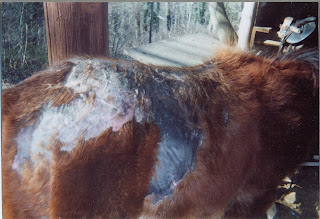 Keep in mind...this is a worst case scenario.
 Your horse doesn't have to look like this in order to have rain rot. Most rain rot is just
little bumps and
little tufts of hair. He had terrible rain rot under a heavy winter coat and I had no idea just how bad it was until I treated it and all of those tufts of hair sloughed off, taking all of his hair with it!

Here he is awhile later with hair growing back.
And a little later - hair all back! :D

Through what I've heard, some say it's a fungus and some say it's a bacteria.
It is an infection of the skin, caused by a bacteria called Dermatophilus congolensis. If you're like I was, you probably don't
really care too much what it's called, you just want it
gone! It's ugly and disgusting but more importantly: it is an infection which often goes unnoticed and therefore untreated for what can be a long period of time.
A secondary staph infection is very common with rain rot. I don't know about you but just the word "staph" is very scary to me. Also, as you can imagine, long term, untreated infections can really take away from the health, condition and overall well-being of your horse, which will also affect their mood and performance.
The bacterial infection causes what are basically sores on the horses' skin.. The sores are typically across the back, (wouldn't you know it - in the saddle area?), across the hindquarters and the neck. They can appear on the back legs as well but are more common on the larger parts of the upper body. These sores can be so small that they're barely noticeable or as large as an inch in diameter. These sores leak puss (how many ways can you say
Ewww?), which sticks to the horses' hair, dries up and creates little hard, stiff, matted tufts of hair. When you scratch or brush your horse, the tufts of hair come off, usually bringing the scab with it. This leaves a bare spot of skin, which can be gray and dry or pink and raw looking. The longer the hair, the bigger the scab and
matts of hair, therefore the bigger the bare spot is when the tuft falls off or gets plucked out.
Now, I've read things that say something like:
'studies have shown it is not itchy, painful or irritating to the horse' and on that...well, sorry folks but I have to say "horsefeathers"! A horse can sense the smallest fly landing on it's skin. How much more can their sensitive skin detect the irritation and the scabs?
Maybe the presence of the bacteria on the skin isn't painful or irritating but I
know that once a horse has rain rot that has developed into scabs,
it is most definitely annoying! and it hurts when those scabs and
matts of hair come off! Depending on how many scabs there are and how big they are, when you brush or curry your horse, it will flinch, jerk, maybe swing its head around or try to move away from you. I think it's pretty much common sense if you think about it - if
your scalp was covered in scabs, don't you think it would be
nonstop irritating and then
painful when you tried to brush your hair? So, it's disgusting
and painful and rain rot is a good term for it! It's a "rotten" little bug so let's figure out how to kill it!
Some say it can be gotten rid of and some people who have had it get in their barns or herds say that you can
never get rid of it. Right now, Shadow shows no signs of rain rot and so
I'm holding to the faith that you CAN get rid of it. Since
the bacteria that causes rain rot can lie dormant on the skin for weeks (or months) before creating another outbreak, I know that rain rot is an incredibly stubborn problem and in order to get rid of it, you have to be serious about it and aggressive and diligent in your methods. The more horses that are involved, the more difficult it's going to be, without a doubt. I also have to say here that probably the only reason I was successful in getting rid of Shadows' rain rot is because we removed him from the large herd he used to be a part of, in which several horses had rain rot. Those horses weren't ours and I had no control over their treatment. If Shadow was still a part of that herd, I'm sure he would still have rain rot. So, you have to either be able to treat them all and if that's not possible, consider removing your horse.
The bacteria that causes rain rot
thrives in wet conditions but contrary to what some say,
your horse does NOT have to stand out in the rain for long periods of time in order to get it.
Rain rot can appear in simply hot and humid areas, so those of us in the hot, muggy South are much more likely to see it than someone living in a hot, dry area out West.
Rain rot usually starts in hot months but
absolutely can continue to live and thrive on your horses skin all throughout the cold winter months if it's not dealt with. It doesn't go away just because the hot, humid summer is over and your horse now has a thick winter coat. The bacteria and the infection are still there (and the sores and scabs).
Because it's a bacteria, rain rot
thrives where there is little oxygen, much like the bacteria that causes thrush in hooves or how tetanus gets started in a wound that has closed over.
Rain rot gets a hold when the bacteria is trapped on the horses' skin and is then covered by dirt and loose hair and then moisture is added. (This moisture can come from the sweat of the horse, heavy humidity in the air or rainfall).
This layer of dirt, hair and moisture acts as an almost airtight "blanket" lying on top, sealing the bacteria and moisture onto the horsesskin and sealing the air out! It's no wonder bacteria grows! This "blanket" of dirt and hair create the perfect breeding ground for rain rot to get started and explode in growth. So - - These last two things tell you right away that the thing you can do to help prevent it (and treat it) is to keep that dirt and loose hair curried and groomed out. In fact, I'd go so far as to say that
a good brisk curry and brushing every day is the #1 most important thing you can do in the battle against rain rot. Keep your horse clean enough so that air can get to your horses' skin and the chances of getting rain rot are much slimmer and the chance of clearing out a current case of rain rot is substantially better.
During the warm months, don't put a blanket on your horse when it's raining. By doing so, you're contributing to cutting off the air supply to the horses skin and holding in the heat and moisture - a perfect breeding ground for rain rot.
Rain rot is highly contagious and easily spread from horse to horse. It can be spread by sharing brushes or tack but it can also be transmitted by the horses just sharing space in which they're going to be touching or rubbing against one another. Needless to say, this means that if one has rain rot, chances are they are all carrying the bacteria and therefore all of the horses should be treated. If you are in a boarding situation where you cannot control the treatment of the other horses, then I know from experience that you're going to have an extremely difficult time getting rid of it. In that type of situation, you may never fully get rid of it but you can help keep it down so the horse doesn't continually have scabbing.
If you can't do anything else in a barn sharing situation, don't share brushes and tack. I also know from personal experience that
some horses are much more prone to get rain rot than others. In a herd of 30 horses, one or two may get a terrible case of it that covers a large part of their body (and can seem almost impossible to get rid of), 5 may have one or two small spots of it that never grow (and never go away either), 1 or 2 may get a spot of it, (which goes away as quickly as it came), and the other 20 or so horses may
never show any signs of it at all! I don't know if this is because of something as complicated as genetics or the immune system or something as simple as different amounts of natural oils in each horses' skin. I consider it just like some people are more susceptible to sinus infections or getting poison ivy on their skin than others and likewise, all horses' are different, too.
If you think (or know) your horse has rain rot, here is what I'd advise you do:First, I highly recommend you call a vet. The vet will need to determine that it is indeed rain rot and not ringworm, which looks quite similar but is a fungus. A vet also needs to determine if the horse needs
antibiotics, which they most likely will and I think is a good way to
get started in getting rid of the rain rot. Notice I said
get started in killing rain rot. Penicillin and other antibiotics are extremely effective at killing the rain rot but the problem is that even though they will clear up the rain rot
on your horse, for awhile, that bacteria is still living and thriving on most everything
in your barn: your tack, your brushes, your blankets and is just waiting to be redeposited on your horse, where it will cause another outbreak on your horse just as soon as the
antibiotics have run their course.
I think penicillin or other antibiotics are fantastic to quickly get the infection and scabs to go away on your horse but you can't rely on antibiotics on a regular basis. I'd use them once, maybe twice but I firmly believe that overuse of antibiotics in any animal (including people), suppress the immune system and in the long run cause more harm than good. I definitely wouldn't use antibiotics any more often than once a year unless there is a very serious or life threatening situation that absolutely requires antibiotics.
As soon as the vet starts your horse on antibiotics,
wash all of your saddle pads and blankets or sheets in warm, soapy, water. (I throw them in the washing machine) If your items are white, add a cup of
bleach to the water. If your items include colors that you don't want to bleach, (or you don't like bleach) add a cup of
vinegar. Vinegar kills bacteria, too. (White or apple cider vinegar will do)
Thoroughly curry and brush your horse and then wash and sterilize all of your grooming supplies. Yep, all of it. Fill a large bucket with hot, soapy water and add a cup of bleach or vinegar and just chuck it all in there and allow it to soak for 5 or 10 minutes. Rinse it well and lay it all out to air dry.
It's important to remove the scabs from the horses' skin so you can also remove the puss and surface infection. You can just brush and pick them off but your horse may not appreciate it. The easiest and least painful way to remove the scabs is to use
Shapley's product M-T-G (which stands for Mane & Tail Groom). Be warned, it stinks a little bit and it
is greasy but it's great stuff! The oils in M-T-G softens the scabs, makes them slid off easily and it also soothes the horses skin. Now, I need to warn you that when the scab comes off,
all of the hair attached to that scab comes off, too so it is possible that your horse will have a bald spot every place there was a scab. If there are just a few scabs, no worries. But if there are a lot of scabs, then you're likely to have quite a bald horse. The good news is that once all of the scabs are removed, the condition will heal much faster. More good news is that M-T-G is famous for helping hair to regrow quickly, so you should see new hair growing in within just a few days.
For the first 2 or 3 days of your horse being on antibiotics, I would recommend not grooming them and not saddling up and riding them if possible. Not only will this give the raw areas time to heal, it will allow the antibiotics time to kill off the bacteria so you don't reinfect all of your clean tack and grooming supplies which would totally defeat the purpose of all of that disinfecting work. If you must groom or tack up, then I highly recommend that you wash everything that touched your horses' skin that day - again. Yeah, it's a pain but I think it's necessary in order to be sure you're killing off all of the bacteria possible.
After the first 2 or 3 days, you can then go into daily currying and brushing. It is extremely important to get rid of the loose hair and dirt and allowing air to get to the horses' skin. Don't drive yourself nuts and wear your arms out brushing one horse, trying to get every speck of dirt off of them. Just a brisk curry and brushing will do.
Also after the first 2 or 3 days, you will want to bathe your horse and then maintain weekly bathing until the rain rot is healed. Bathe them weekly for as long as it takes and about 6 weeks should do it, maybe a little less, maybe more. You can buy and use a
antimicrobial shampoo but I know a homemade shampoo consisting of liquid Ivory dish soap and iodine works just as well, if not better! (and it's cheaper!) I've included the recipe for this shampoo and directions for bathing in another post.
Also weekly, (preferably around the same that you bathe your horse), you will want to
sterilize everything that regularly comes in direct contact with the horses' skin: brushes, combs and all grooming supplies, saddle pads, blankets, fly sheets, etc. Wash them as described earlier.
I know it sounds like a lot but honestly, once you "get into the groove" of things and get yourself a routine down, it's really not that bad. (Unless of course, you own 10 horses and if that's the case, you have my sympathies for all of the washing and shampooing you're going to be doing.) I recommend that as you're heading out the door to go shampoo your horse, throw a load in the washing machine, and fill up a bucket of your hot, sudsy bleach or vinegar water and toss in only the brushes and things that have touched your horse in the last week. Once you've finished bathing your horse, you already have the hose out, so rinse out your grooming items and lay them out to dry.
Hey! look at the bright side! I suggest
weekly. A lot of resources say you must bathe your horse
and wash your equipment
every day for a week! You can do that if you want but with using antibiotics and M-T-G and currying and brushing your horse every day, I really don't think it's necessary.
Ok, I know that was a lot of information so
Here's a recap:
- Call a vet (is it rain rot or ringworm and are antibiotics necessary?)
- Begin antibiotics (if prescribed)
- Wash all of your pads, blankets, sheets and grooming supplies
- Apply a product such as M-T-G to remove the scab, soothe the horses' skin and begin healing
- Curry and brush your horse daily
- Bathe your horse weekly
- Wash all of your gear weekly and use only clean items on your freshly bathed horse.
I firmly believe that if you follow this regime, you can defeat rain rot! If you have other suggestions or a success story on how you beat rain rot, I'd love to hear it! Scroll down to the "About Me" section and click on "View my complete profile" to send me an email!
Best of luck!


